Wednesday, 30 January 2019

Employee-Owned Landscape Services Company Earns Carolinas Chapter Award

ESOP

The Greenery, Inc. was named the 2018 Employee Owned Company of the Year by the Carolinas Chapter of the national Employee Stock Ownership Plan Association for effectively meeting the criteria of communicating the benefits of employee ownership as it relates to the success of the company. Established in 1973 and based in Hilton Head Island, SC, The Greenery is an employee-owned company in coastal South Carolina and Georgia and nearby regions with comprehensive landscaping services including residential and commercial landscape installation and maintenance, hardscapes, and irrigation.

ESOP

Group of The Greenery, Inc. employees

There are approximately 100 ESOP companies that comprise the Carolinas Chapter in South Carolina and North Carolina and it is part of the national ESOP Association, based in Washington, DC. An employee stock ownership plan (ESOP) is an employee-owner program that provides a company’s workforce with an ownership interest in the company.

In receiving the Carolinas Chapter award, The Greenery demonstrated that it nurtures a sense of ownership among its more than 450 employees. The company celebrates this achievement while also celebrating its 46th Anniversary in February and its 11th anniversary as an employed-owned company.

ESOP

Lee Edwards, CEO, The Greenery, Inc. of Hilton Head Island, SC accepts a 2018 Employee Owned Company of the Year award.

Lee Edwards, The Greenery’s CEO, stated, “We were honored to be recognized within our ESOP Chapter for both South Carolina and North Carolina for our efforts to educate and encourage our employees about the values and benefits of employee ownership. We believe that every employee owner can contribute to the actual success of their company.”

The company’s Chief Financial Officer, Scott Slawson, oversees the internal committee responsible for communications about the employee stock ownership plan, and stated, “The hard work throughout the year really paid off. The Carolinas Chapter award put us in contention for a national award, and although we did not win it, it was an honor for the whole company to be among the top ESOP groups in the nation.”


The post Employee-Owned Landscape Services Company Earns Carolinas Chapter Award appeared first on Turf.


from RSSMix.com Mix ID 8230377 http://bit.ly/2GaU1oJ
via IFTTT

Project EverGreen: Swinging For The Fences For Kids

Phoenix, Arizona

Project EverGreen, the national nonprofit devoted to creating a greener, healthier, cooler Earth; the Sports Turf Managers Association (STMA), the city of Phoenix Parks and Recreation Department, local businesses and residents teamed up on January 21 at the half-a-century old Lindo Park in South Phoenix, AZ to give the 22-acre park something the community has always wanted: a real ball field.

Phoenix, ArizonaVolunteers including sports field managers, lawn care professionals, landscape contractors, groundskeepers and neighborhood youth assisted with the transformation that had an estimated value in excess of $50,000.

The project included:

  • Surveying the field to determine existing and proposed elevations for the playing surface.
  • Laying out new grass edges along 1st and 3rd base lines.
  • Re-inspecting and adjusting the irrigation system to insure proper coverage in the outfield.
  • Fertilizing and silting seed for the outfield turf – nearly 60,000-square-feet.
  • Laying out and rebuilding the pitcher’s mound and installing a new pitching rubber.
  • Laying out and rebuilding the batter’s boxes/catcher’s box and installing a new home plate.
  • Grading the infield surface to cut high areas and fill low areas.
  • Installing sod to repair areas of damaged turf.

“Neighborhoods deserve a healthy park or community green space that they can call their own,” says Cindy Code, executive director of Project EverGreen. “Thriving parks create a community hub for neighbors – young and old – to connect and helps to instill pride in their community and confidence in area residents, and creates a place for adults and youth to exercise and have fun.”

Phoenix, ArizonaSTMA supported the renovation project by having more than 100 professional sport turf managers on site.

“We were thrilled to be a part of this important project and bring a well-managed and playable ballpark to a deserving community,” says Kim Heck, CAE, CEO of the STMA. “To use our professional expertise and know-how and bring a plan like this to life is a win-win for everyone.”

Project EverGreen has renovated more than 32 community parks across the country since 2006. In January of 2018, the city of Phoenix Parks and Recreation Department and community leader Muriel Smith nominated the park for a new ballfield.

“This is an exciting project for the community,” said Councilwoman Felicita Mendoza, who represents District 8 in which the park is located. “We’re grateful that Lindo Park was selected by Project EverGreen and for the volunteer service and financial support of STMA and local businesses to make it possible. The new ballpark will enhance the recreation center and other amenity upgrades made to the park in recent years. “

Smith, 72, has lived in the community surrounding Lindo Park for four decades. She has raised three children, 13 grandchildren, and six great-grandchildren; many of whom grew up playing in Lindo Park.

Phoenix, ArizonaOver the years, Smith worked with the city of Phoenix Neighborhood Services and Parks and Recreation departments, Phoenix Police Department, former District 8 Councilwoman Kate Gallego and District 7 Councilman Michael Nowakowski. They worked with local high schools and hosted graffiti clean-ups on the weekends, and things turned around and the park became a place to gather again.

Since then, a recreation center named after Smith was built in Lindo Park in 2016 along with a large ramada with picnic tables for gatherings outside and a new playground. Now, neighborhood groups hold meetings, host tree plantings, put on special events and kids read and study there.

“This ballpark will be the icing on the cake for the kids in this community,” said Smith.

A city parks and recreation department and/or a community group can nominate a park for revitalization. Once selected, Project EverGreen works with local businesses, community groups and volunteers to transform and sustain community green spaces.

The post Project EverGreen: Swinging For The Fences For Kids appeared first on Turf.


from RSSMix.com Mix ID 8230377 http://bit.ly/2HECNmb
via IFTTT

Tuesday, 29 January 2019

Plowsite: This Week’s Cool Threads

snow management professionals

From feedback on hourly rates to advice on a snow removal equipment purchase, popular questions posted by the ice and snow management professionals on PlowSite forums this past week.

BUSINESS FUNDAMENTALS

  • A new PlowSite Member from Minnesota is looking for feedback on his hourly rates for a commercial plowing job. Share your thoughts… 
  • A Junior Member from Southwest Pennsylvania wants to know how long other members’ plow routes take them to complete. Share your thoughts…

TRUCK & EQUIPMENT REPAIR

  • A Junior PlowSite Member is having trouble with his hitch pins when he hooks up his plow, and he wants to know if this is damaging his equipment in any way. Share your thoughts…

COMMERCIAL SNOW REMOVAL

  • A Junior PlowSite Member from North Jersey is looking for advice on how to efficiently plow an apartment complex parking lot that has some very long runs. Share your thoughts…

RESIDENTIAL SNOW REMOVAL

  • A Senior Member from North Dakota is looking to add another tool for snow removal from a flat roof. Do you have any experience with the products he’s considering? Share your thoughts… 


PlowSite is the largest and most active online forum servicing snow and ice management professionals.

As the only resource of its kind in the marketplace, PlowSite has been a coveted place for snow and ice management professionals seeking peer-to-peer networking, business guidance and insight into industry best practices and trends since 2000.

snow management professionals

Join your industry peers in this growing, dynamic community today:
Register For FREE!

The post Plowsite: This Week’s Cool Threads appeared first on Turf.


from RSSMix.com Mix ID 8230377 http://bit.ly/2FV4OnL
via IFTTT

Monday, 28 January 2019

LawnSite Forums: This Week’s Hot Threads

lawn mowing

From buying new boots to keeping yourself motivated, here are some questions from the landscape professionals on LawnSite forums this past week.

BUSINESS OPERATIONS

  • A LawnSite Senior Member wants to buy new boots and is looking for opinions. Requirements are that they are waterproof and lined, slip resistant, have a composite toe, and good treads. Share your thoughts… 
  • A LawnSite Member wants to know what types of payment apps other forum members like. He accepts checks and some credit cards, and has had a few customers ask if he takes PayPal. Share your thoughts… 

LAWN CARE BUSINESS MANAGEMENT

  • A LawnSite Member in his third year of business would like to know if yard signs or door hangers are more likely to land him more maintenance accounts. Share your thoughts… 

LAWN MOWING

LAWN MOWING EQUIPMENT

  • A LawnSite Bronze Member from SE Wisconsin is shopping for new ear protection. He wants to know if ear buds on their own provide enough protection, or if he can/should wear ear protection over them. Share your thoughts… 

Do you need feedback on a professional challenge you’re facing within your landscaping or lawn care business? Tap into the wealth of knowledge at LawnSite, the largest and most active online forum serving green industry professionals.

As the only resource of its kind in the marketplace, LawnSite has been a coveted place for landscape professionals seeking peer-to-peer networking, business guidance and insight into industry best practices and trends since 1995.

lawn mowing

Join your industry peers in this growing, dynamic community today:
Register For FREE!

The post LawnSite Forums: This Week’s Hot Threads appeared first on Turf.


from RSSMix.com Mix ID 8230377 http://bit.ly/2CPQn0g
via IFTTT

Thursday, 24 January 2019

Porous Pave Installations Used 13M Pounds Of Recycled Rubber Last Year

paving material

Porous Pave, Inc. reached a new environmental milestone in 2018: surpassing 13 million pounds of recycled rubber used in installations of its permeable paving material. An eco-friendly green building product made in the U.S., Porous Pave is a highly porous paving material that offers superior permeability for optimal storm water retention, exceptional application versatility, and demonstrated durability. The controlled shredding and processing of recycled tires produces the fine-cut chips of recycled rubber incorporated into Porous Pave.

paving materialWith 27 percent void space, Porous Pave infiltrates storm water on site, decreasing runoff into storm drains and sewers. Porous Pave XL is the company’s strongest, heavy-duty formulation for hard-wearing permeable pavement. XL combines equal amounts of recycled rubber chips and kiln-dried aggregate mixed on site with a moisture-cured, liquid binder. For more impact-absorbing permeable surfacing, the XLS formulation is made with 100 percent rubber chips mixed with a softer binder.

“Topping 13 million pound demonstrates that facility managers, public garden administrators, public works officials, landscape architects and contractors continue to trust our proven product for their permeable paving applications,” said Dave Ouwinga, president, Porous Pave, Inc.

“Porous Pave fulfills our requirements for permeable pavement,” said Jack Carman, FASLA, RLA, landscape architect, Design for Generations, a landscape architecture firm specializing in the design and development of therapeutic gardens and landscapes. “It provides greater porosity than permeable pavers, it is non-slip and gives off less reflective glare than concrete, and its texture and colors enable us to harmonize permeable pavement within our garden designs.”

Design for Generations and Eric’s Nursery and Garden Center, a full-service landscape design-build firm, installed 3,000 square feet of Porous Pave XL as part of its McCauley Convent Tranquility Garden project. When the courtyard garden they developed for Meadowood Senior Living also required 8,100 square feet of permeable paving to meet storm water management regulations, the firm again selected Porous Pave.

The post Porous Pave Installations Used 13M Pounds Of Recycled Rubber Last Year appeared first on Turf.


from RSSMix.com Mix ID 8230377 http://bit.ly/2RMhrrC
via IFTTT

The Invasive Spotted Lanternfly: Know What To Do

spotted lanternfly

By Christine Menapace

Landscapers in Pennsylvania, New York, New Jersey, Delaware, Maryland, and Virginia need to be on the lookout for a new invasive insect, the Spotted Lanternfly (SLF), or lycorma delicatula. Feeding on the sap of over 70 types of plants, the planthoppers cause significant damage and even death to ornamentals and nursery plants, as well as forestry and agricultural crops. Many areas where the insect has been found are now under quarantine and landscapers in these areas need to know the rules to avoid fines. Those in bordering areas are urged to help stop the spread of this destructive insect.

spotted lanternfly

Spotted Lanternfly in Chester County, PA

Native to parts of Southeast Asia, the SLF was first identified in the U.S. in Berks County, PA in 2014. Since then, it has spread to 12 other counties in PA, including Monroe, Carbon, Schuykill, Lebanon, Lancaster, Chester, Montgomery, Lehigh, Northampton, Bucks, Philadelphia, and Delaware. In 2017, it was spotted in Frederick County, VA. Last year, three NJ counties, Mercer, Warren, and Hunterdon, were added to the list of quarantined areas. This past September, a single adult insect was found in both Albany and Yates counties of NY.

In areas under quarantine, such as PA and NJ, movement of such things as yard waste, firewood, nursery stock, and other elements of landscaping are restricted. While the insect can only jump or fly short distances, they lay their eggs on any number of surfaces, such as trees, vehicles, and outdoor articles, and thus spread easily from human activity.

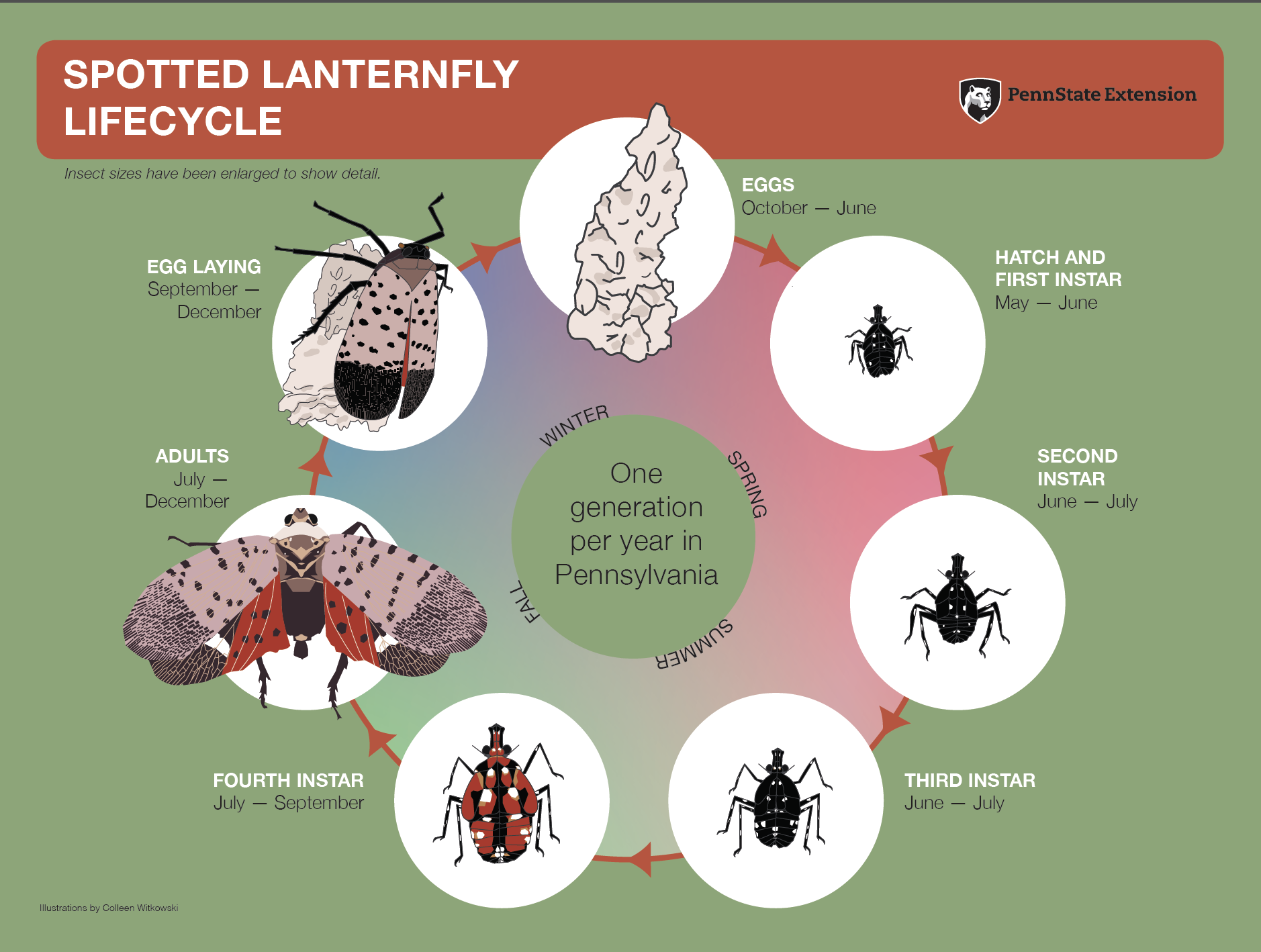
So what can you do? First, be able to identify the SLF in all its five stages of growth. (See Illustration.) The first four stages are nymphs, which are incapable of flight. The young nymphs are black with bright white spots and about the size of a pencil eraser. The next stages are similar, but the nymphs become larger. The fourth stage, prior to adulthood, is vibrantly red with distinct patches of black and equally distinct bright white spots. The adult is a leafhopper with 1” long grey wings with black spots that when opened, reveals a bright red underwing. SLFs live through the winter only in egg masses, which can be found from late fall to early spring.

spotted lanternfly

Click to enlarge. (Illustrations by Colleen Witkowski)

Those finding a SLF or a suspicious looking egg mass, should try to destroy it. However, if it is found in an area previously not known, try to kill and preserve it (a container filled with rubbing alcohol or hand sanitizer should work) or at least take a picture and report the sighting to the appropriate state authority. (See contacts at the end.)

Other evidence of SLF are oozing wounds on bark that leave a greyish or black trail. As SLF digests sap, it excretes a substance known as honeydew that, along with sap from these weeping wounds, can attract bees and other insects. There may be a buildup of this sticky fluid on infested plants and on the ground below. The honeydew and sap also provide a medium for growth of fungi, such as sooty mold, which can cover leaf surfaces and stunt growth.

If working in a quarantine zone (which can change as new discoveries are made), know the rules and get a permit where necessary. In PA, a permit provides evidence that you have complete training on the rules of the quarantine order. To obtain a permit, you must take a “train the trainer” free online course, found at https://extension.psu.edu/spotted-lanternfly-permit-training, to teach your employees the compliance procedures.

When traveling in and out of the quarantine zone or even nearby, check your car (including underneath and the wheel well) and any outdoor equipment such as landscaping supplies, mowers, etc. Keep your windows rolled up when you park. Don’t store things or park under infested trees, and don’t move firewood. Also avoid moving woody plant debris (e.g., fallen trees or branches and tree trimmings) and any living plants, equipment, building materials, or other objects.

When working in a quarantined area, if possible chip all woody debris on-site to no larger than 1-inch pieces in each of two dimensions. Ideally, leave all chips or woody debris on-site. The next best option is to take chips or debris to an organic materials recycler within the quarantined area. In PA quarantine zones, if you sell and/or produce mulch you will need to enter into a compliance agreement with the Pennsylvania Department of Agriculture (PDA). (See section below on composting tips to kill SLF.) These regulations do not apply to grass clippings or autumn leaf collection.

Even in areas not yet affected, landscapers may want to recommend clients remove and/or treat any tree-of-heaven (Ailanthus altissima) on their properties, as this is the SLF’s preferred host. Apply herbicide to the tree from July to September and wait at least 30 days before removal. (Failure to apply herbicide will result in new growth from the stump.) In the Spring, band highly infested trees with sticky tape to trap the nymphs crawling up the trees to feed. For both nymphs and adults, insecticides can be used. The most effective ingredients studied include dinotefuran, imidacloprid, carbaryl, and bifenthrin. For a list of products and an IPM guide, see Resources.

Composting To Kill Spotted Lanternfly

To kill viable insects or eggs in chipped material, the following composting procedure can be used:

  • Compost piles must be a minimum of 200 cubic yards. Internal temperature at a depth of 18 inches must reach 140°F (60°C) for four continuous days.
  • After the interior is heat treated, rotate the exterior of the pile to the center. Using a front-end loader or a bulldozer, remove the outer layer of the compost pile to a depth of 3’.
  • Start a second compost pile using the recently removed cover material as a core. Cover this second compost pile by moving the core material from the first compost pile as a cover at least 3’ deep. The second compost pile should remain undisturbed until the temperature reaches 140°F (60°C) for at least four continuous days.

Spotted Lanternfly Management Calendar

spotted lanternfly

Credit: Penn State Extension


TO REPORT SLF:

Pennsylvania
www.agriculture.pa.gov/Plants_Land_Water/PlantIndustry/Entomology/spotted_lanternfly/Pages/default.aspx
badbug@pa.gov
(866) 253-7189 or (888) 4BADFLY

New Jersey
SLF-plantindustry@ag.nj.gov
(833) 2223-2840

New York
www.dec.ny.gov
spottedlanternfly@dec.ny.gov
(518) 457-2087

Virginia
(804) 786-3515

Delaware
(302) 698-4577

Maryland
(410) 841-5870

RESOURCES:

Instructional Video from the New Jersey Nursery & Landscape Association (NJNLA) https://www.youtube.com/watch?v=UI0gIA9oTsg&feature=youtu.be

SLF Conferences For The Green Industry
https://extension.psu.edu/spotted-lanternfly-conference-for-the-green-industry

SLF Insecticides Guide
https://www.nj.gov/agriculture/divisions/pi/pdf/SLFIndustryguidelines.pdf
https://extension.psu.edu/spotted-lanternfly-ipm-management-calendar

Brochure For Homeowners
https://extension.psu.edu/spotted-lanternfly-management-for-homeowners


The post The Invasive Spotted Lanternfly: Know What To Do appeared first on Turf.


from RSSMix.com Mix ID 8230377 http://bit.ly/2RaoCos
via IFTTT

Thursday, 17 January 2019

Top 2019 Garden Trends

From enthusiastic horticulturists to casual garden tenders, homeowners across New Jersey want their yards and gardens looking beautiful and well maintained. Although we are still in throes of winter, it is never too early to start planning your garden for the warmer weather or consult with a landscaper. For those who are looking to update their homes with contemporary garden design ideas, there are plenty of popular garden trends emerging in 2019 that you can incorporate into your own yard.

ADAPTABILITY FOR EACH SEASON

In New Jersey, we are lucky that we get four distinct seasons every year. It also means that an enormous range of plants can grow in our area throughout different times of the year. Take advantage of that by creating a garden that looks beautiful all year round.

How to do it: Throughout your yard, incorporate plants that do well during different times of the year. Planting bulbs that will begin to sprout at the start of spring will get your garden going as the weather starts to warm up. Adding evergreen shrubs and topiaries will ensure that your yard has some green in it during the winter, while a tree that will showcase fall colors will highlight your yard in autumn. Finally, adding decorative flower pots throughout your yard can make it easy swap out plants to reflect seasonal colors and themes.

CREATE FOCAL POINTS

Focal points in and of themselves are not necessarily a new idea when it comes to landscaping and gardening. However, the latest trend is to come up with creative and unique items to showcase a particular area of your yard. The more imaginative you can get, the more spectacular your garden will be.

How to do it: We often pick beautiful trees or fountains as the focal point of a garden, but we’d encourage you to think outside the box! Spruce up a tool shed with a fresh paint job and some accenting plants and shrubs. Surround a comfy hammock or bench swing with colorful flowers and decorative boulders. Even your child’s playground or pup’s dog house can be the main feature with a little work. Take your creative focal points to the next level by installing alluring light fixtures to illuminate your yard’s centerpiece.

SUSTAINABILITY

When we talk about sustainability, we’re referring to adding elements that can promote the health and longevity of your garden without direct intervention. Not only does this help with the workload of maintaining your garden, but it can also save you some of the expense. Sustainable elements can also offer a variety of benefits to our local ecosystem.

How to do it: Think of ways to be eco-friendly! Choose a landscape design that promotes healthy water flow or install an irrigation system. Plant vibrant flowers to attract bees, butterflies and other pollinators. Incorporate decorative bird baths or bird feeders to encourage wildlife to visit your garden. Consider building structures to house compost, firewood or other yard debris that can be repurposed in your garden.

KEEP IT SIMPLE

You don’t need to be a master gardener to have a visually pleasing yard. With a little planning, you can create beautiful garden accents around your home that increase your home’s elegance and are simple to maintain. In 2019, it won’t be uncommon to see a “less is more” approach to gardening – especially in busy households.

How to do it: In New Jersey, there are plenty of plants that are easy to care for and will flourish in the area’s climate. For a garden that doesn’t require consistent re-planting year after year, we suggest filling your garden with a variety of perennials. Other good options are large leafy plants, such as coleus, plantain lilies, and ferns, which take up more space and therefore eliminate the need for additional filler plants in your garden. If you can, build an automatic sprinkler system to help save some time watering your plants. Finally, don’t be afraid to add non-living elements to your garden that don’t need as much attention, such as decorative boulders, structures, and patios.

Using a little inspiration from these 2019 garden trends, this year can be the year that you make your home and garden the peaceful and relaxing space you want it to be.

The post Top 2019 Garden Trends appeared first on Borst Landscape & Design.


from RSSMix.com Mix ID 8230377 http://bit.ly/2szmU5Y
via IFTTT