Friday, 15 March 2019

Biologicals On The Greens

Biologicals On The Greens

From Biological Products Industry Alliance (BPIA)
From the Spring 2019 Issue

There is nothing more fun than waking up early on a Saturday morning and meeting some good friends to play a round of golf on a meticulously maintained course. It doesn’t matter whether it is your private country club or your local public course. Everyone enjoys playing on a good looking and pest-free course. Conversely, nothing is more miserable than trying to golf on a course that is in poor condition from turf disease or being overrun by a variety of buzzing and stinging insects.

Biologicals On The Greens

(Photo: Bedney Images)

Two decades ago, most players wouldn’t have given a second thought as to what goes into maintaining their favorite place to play golf. They just wanted it to look scenic and be pest free. But times have definitely changed. Many people including golfers and golf course superintendents are trying to be ecologically responsible and live lifestyles which help sustain our natural resources and protect all aspects of our outdoor environment including on golf courses.

For many years, golf course superintendents and their staff used a diverse assortment of very effective synthetic chemicals to eliminate unwanted pests and help improve the appearance of greens. The reality is that little consideration was given to the environmental consequences, and also there were very few efficacious alternatives available.

“The market is definitely shifting since there are now many cost-effective biological products available for use on turf,” says Eric Smith, East Coast sales manager for BioSafe Systems.

“These biopesticide products include a wide variety of natural pest control options such as bacteria and fungi that can be just as effective as man-made chemistry but have little or no effect on human health or the environment,” Smith continues.

There are now commercially available biopesticides that control hundreds of insect species commonly found on the tees, fairways, and greens of golf course sites, including the following: Nematodes; Chinch Bugs; Grubs; Sod Worms; Billbugs; Cut Worm; Armyworm; Weevils; Mole; Crickets; and Mites.

Many of these products meet all the requirements of the USDA National Organic Program and now play a critical role in Integrated Pest Management, or IPM, plans for pest and disease control on courses. (More information about the USDA National Organic Program can be found online.)

Biological products are reduced-risk products based on biological or naturally derived chemistry. The Biological Products Industry Alliance (BPIA) defines biopesticides as reduced risk pesticides that are naturally derived or synthetic equivalents of natural materials such as animals, plants, bacteria, fungi, and certain minerals, generally posing little risk to humans or the environment. A biostimulant is defined as a substance or micro-organism whose function when applied to seeds, plants, or the rhizosphere is to stimulate natural processes to enhance or benefit nutrient uptake, nutrient efficiency, tolerance to abiotic stress, and crop quality or yield.

New Age In Pest Control And Turf Growth

The willingness to try these innovative but natural products can sometimes be generational.

“The job of golf course superintendent can be stressful with a great deal of pressure to maintain the appearance of the course, so a veteran superintendent might tend to rely on conventional chemistry and daily spraying,” says Smith. “But a new superintendent looking to make their mark might say, ‘I’m going to do things in a different way, which now includes some courses that have gone completely biological with their programs.’”

Biologicals On The Greens

Shown here is a natural bacteria eliminating an insect nymph. (Photo: Biological Products Industry Alliance (BPIA))

A common misconception about biological products is that they will be difficult to use because they often include application of a living organisms to the turf. In recent years, a great deal of work has gone into simplifying the application process for biological products. Typical directions are to simply mow the greens and run irrigation prior to application to help with saturation then apply a wettable powder formulation that can easily be sprayed on turf grass. Once a kill is achieved rake to remove the unwanted organisms such as moss and reapply as necessary, thoroughly irrigate, and within 24 to 48 hours re-seed.

“There are many reasons golf and turf markets have begun to incorporate biological products into their programs,” says Darrell Thorpe, regional sales manager for Agrinos. “For one, biostimulants can provide improved soil and plant heath, which directly results in greener, more attractive golf courses. They also increase turf tolerance to environmental stressors like heat, drought, or excessive rain.  Finally, there are important environmental benefits associated with using microbials and other biostimulants, such as increased fertilizer efficiency, reduced runoff, reduced CO2 emissions, better water utilization, and reduced water usage.”

Biologicals are an investment in healthier soils, and healthier soils mean healthier grass. Some biological products, for example, can increase root biomass—and since superintendents trim the growing point off the grass every few days, using biologicals will help their fairways stay greener, resulting in a more attractive golf course for players and the community.

“Biostimulant products provide benefits by strengthening the soil microbiome and delivering critical, highly bioavailable nutrients to help plants prosper,” says Thorpe. “Once integrated into the golf course superintendent’s practices, biological products have been proven to perform consistently across a broad range of plants, soils, and environments.”

Greens May Get Greener

While Saturday morning golfers still want to play on nice looking courses without being subjected to bothersome insects or other annoying pests, increasingly they now also care about how that course is being kept in such an enjoyable and pleasant condition and whether there are any harmful environmental consequences of that maintenance. As a result, the use of biological products such as biopesticides and biostimulants on golf courses is sure to continue to grow and help make the fairway greens a lot greener in more ways than one.

The Biological Products Industry Alliance (BPIA) is the premier organization dedicated to fostering the use of biological technology including biopesticides and biostimulants. BPIA is a rapidly growing association with now over 130 member companies ranging from small, innovative sole proprietors to large, international companies. Member companies have developed dependable, pioneering products for commercial agriculture, forestry, home gardens, horticulture, ornamentals, public health, and turf.

Do you have a comment? Share your thoughts in the Comments section below or send an e-mail to the Editor at acosgrove.turf@groupc.com.

Golf Courses: Healthy Land Stewardship

Compiled by Turf Staff

The Golf Course Superintendents Association of America has recognized 12 winners for its 2018 Environmental Leaders in Golf Awards (ELGA). Given since 1993, the awards were updated to recognize superintendents in focused areas of environmental sustainability. Instead of offering national awards based on facility type, the new version of the ELGAs is based on the environmental best management practices and honor specific areas of focus: Natural Resource Conservation; Healthy Land Stewardship; Communications and Outreach; and Innovative Conservation.

The 2018 Healthy Land Stewardship Award was given to Shannon Easter, golf course maintenance director of Broken Sound Club in Boca Raton, FL.

The 21-year GCSAA member’s soil program incorporates organic, biological, and carbon-based products to improve soil health while repurposing the courses’s organic waste material into reusable compost that is spread on the course. The integrated pest management (IPM) plan at Broken Sound employs proper cultural practices, mechanical controls or biological controls first, with chemicals only used as a last resort. The property features many lakes, providing potential habitat for wading birds. By adding more than 20,000 plants along the lake beds in the past five years, the course’s population of wading birds has increased by 75%. The property also includes 30 snags to attract large birds of prey, 30 birdhouses, seven butterfly gardens and 22 beehives that have produced 1,500 gallons of honey.

First runner-up in the Healthy Land Stewardship category is Jeff Reich, superintendent at TPC River Highlands in Cromwell, CT. Second runner-up is Wayne Mills, superintendent at La Cumbre Country Club in Santa Barbara, CA.

Biologicals On The Greens

Today, more golfers care about how a course is being kept and if there are any harmful environmental consequences from maintenance practices. (Photo: Bedney Images)

The post Biologicals On The Greens appeared first on Turf.


from RSSMix.com Mix ID 8230377 https://ift.tt/2FdThOI
via IFTTT

Thursday, 14 March 2019

Looking To Increase Your Rates?

selling landscape services

By Andrew Duncan
From the Spring 2019 Issue

One of the most common complaints I hear from business owners in the landscape field is that labor rates as a whole are too low. In our business you are always going to be competing with companies underpricing their work, whether that is someone who mows lawns on the side for extra income or a new business who doesn’t fully understand their numbers. As an industry we aren’t very good at creating value, and it is a tough battle when you are trying to bill double to triple what the kid down the street will charge. However, there are companies out there that are consistently getting new customers while still charging profitable rates. What is their secret? Selling.

selling landscape services

(Photo: Bedney Images)

You may think, “Well I’m already selling every time I go meet a potential customer.” Take a hard look at your sales process: are you really selling value, or are you just listening to the customer and giving them a price? The majority of businesses are going to a quote, trying to jot down everything the customer wants, and formulating a price for the required services. This process is not only robotic and impersonal, but also decreases your value as a company. Have you ever gone to the doctor and said, “Hey doc, I have some chest pains,” and had the doctor only reply with, “Okay, that will be $500.”? I certainly wouldn’t trust a doctor who just threw a number at my problem without explaining the issues and their plan of attack. And a landscape company is no different.

I can already hear the grumbles from some of you saying, “What can I really say about mowing grass?” It’s simple—tell them your process. A few years ago, we switched the majority of our mowers to walk-behinds for our residential customers. A homeowner is not going to notice what mower you are using nor are they going to care… until you tell them the reasoning. Once we switched, I started telling all of our new customer leads that we have switched to walk-behind mowers because they have a better cut quality and require the operator to really take their time—which not only makes their lawn look great but also cuts down on tearing up lawns when a stand-on or ride-on mower turns. Almost everyone I met with had some horror story of their previous company always tearing up the edges from turning too quickly. We instantly saw an increase in interest in our services and we were able to win customers, even with a higher price tag than the competition.

This isn’t a knock on ride-on or stand-on mowers either. In fact, at some of our large commercial properties we focus our sales pitch on the efficiency of our larger ride-on mowers and their bagging capacity. It all comes down to your value proposition to that specific customer.

This is even more important when you get into higher end services. If you send a quote for pruning without explaining your process, then you will be compared against companies that offer low quality work. (Think hedge trimmers to a Rhododendron, yikes.) Meanwhile had you explained how your company hand prunes certain shrubs as well as the downfalls of machine pruning specific bushes, you will instantly look better than the competition and can more than likely charge a premium price for your services.

Another, and possibly better example is hardscaping. If you explain the importance of using the correct base material, the correct compactor, and using a laser level to get your pitch absolutely perfect, you will look better than competition who just goes in and gives a paver recommendation and a price, even if they use the same tools and process.

If our industry wants to increase rates, we need to increase perceived value. As operators in the field we know our value but without the customers knowing the importance of a professional company we will never see that price hike. The key to higher prices, better quality customers, long term growth, and a more profitable industry is informing clients instead of just sending out an estimate. Don’t let customers buy just based on price. Let them make an informed decision based on price vs. value. This will not only increase the number of clients won but also increase your worth to that customer and help the landscape industry collectively increase profit.

selling landscape servicesDuncan has worked for his brother Chris in different capacities since 2006 when Central Mass Landscapes, a full service landscaping company based in Worcester, MA, was formed. He attended the University of Massachusetts in the Landscape Architecture program graduating in 2015. Duncan focuses on sales, implementing an outbound marketing and sales program which has grown the company’s commercial landscaping and snowplowing division, as well as the landscape construction and site work divisions.
Do you have a comment? Share your thoughts in the Comments section below or send an e-mail to the Editor at acosgrove.turf@groupc.com.

The post Looking To Increase Your Rates? appeared first on Turf.


from RSSMix.com Mix ID 8230377 https://ift.tt/2u5mJ38
via IFTTT

Wednesday, 13 March 2019

Turfco’s Century of Turf Care

turf care

Being in the same industry for 100 years is an achievement few family businesses can claim. From their grandfather who started National Mower Company in 1919, to the third generation Kinkead executives who run Turfco today, the Kinkead/Turfco ‘family’ acknowledges the privilege it is to be a part of the ever-changing commercial lawn care and landscape industry. The Kinkeads and Turfco want to express their gratitude for all the support, collaboration, and partnership that the company has received from turf care industry professionals over the past 100 years.

“Turfco just wants to say ‘thank you, turf care industry,’ for all the great time spent together working to solve challenges and grow this great industry,” say George and Scott Kinkead, National Mower Company, president and executive vice president, respectively, of Turfco Manufacturing in Blaine, Minn.

To celebrate this milestone, the company has launched a “100 Years of Thanks” giveaway for customers in the landscape industry featuring a Turfco T3100 Spreader and Sprayer Applicator (manufacturer’s list price $10,290) as the grand prize. Five GoPro® HERO7 Silver cameras will also be awarded over the coming months to customers who register for a chance to win at https://ift.tt/2T3X1pK between January 30 and October 31, 2019.

“Scott and I have spent our whole careers in this industry, and this is a tangible way to express our heartfelt gratitude for the opportunities and collaborative partnerships we’ve experienced working with so many great professionals,” says George Kinkead.

The family’s lineage as makers of turf care equipment dates back to 1919. World War I, the “war to end all wars” had recently ended when Robert Stanard Kinkead, a veteran of the war, founded National Mower Company, based in St. Paul, Minn. He started off making reel-type, sickle bar, and pull-behind lawn mowers that could be hitched to horses or tractors. Robert was an engineer during the war and he noticed sickle-bar equipment while overseas. Through the years the company continued its growth with power mowers while rising to national and international prominence as an innovator in commercial-grade mowing products for golf clubs, parks, agriculture, sports, and landscaping industries, among others.

Fast forward to 1961 when Turfco, working closely with local turf specialists, created the first mechanized topdresser. That invention brought the chore of topdressing into the 20th century. Topdressing on golf courses and sports fields used to consist of slinging sand from shovels to maintain and repair high trafficked turf areas. The introduction of the topdresser made it faster, easier, and more consistent. John Kinkead Sr, while still working at National Mower, spearheaded the introduction of many other turf innovations at Turfco.

Under the leadership of the Kinkeads, Turfco thrived as it continued to develop and market new product innovations that helped advance the turf maintenance and landscaping industries.

In the early years, John Kinkead would pack up the family station wagon with a disassembled mower, and travel to demonstrate the product to prospects over six-week periods at a time, gaining input along the way. He had to reassemble the mower at each stop.

For sons George and Scott Kinkead life on the road was made easier as they could pack Turfco equipment for demonstration on a 20′ trailer, greatly improving their on-the-road productivity.

Both George and Scott were rooted in the turf care industry from their early youths, working summers either at the manufacturing plant or in the field for a landscaping company or golf course, leading to their learning about the lawn and turf care businesses almost by osmosis. As they picked up on various aspects of the business, they were surprised to find out that the “UTVs” they raced around with at the family’s rustic cabin were nothing more than souped-up National Mower mowing machines in disguise.

The family perseverance and inventiveness set the tone for how the company would work with the lawn care professionals it sought to serve, to move the industry forward. “We are a company that runs on great customer service, and we get our best ideas for new products from listening to what lawn care professionals tell us are their most pressing challenges, and from observing how turf professionals actually tackle their landscape maintenance programs,” says Scott Kinkead.

Both brothers are committed to spending a significant portion of their time watching and learning from their customers—the LCOs and their staffs—who perform the day-to-day work of commercial and residential lawn care and landscaping management. “We do spend a lot of time in the field, working with end users and performing product demonstrations and the like for the LCOs and their staffs,” Scott says.

“Working side-by-side with LCOs, we often see problems and how they could be solved,” Scott says. They’re pragmatic solutions that seem obvious—in hindsight. But the company’s 100-year heritage of turf-care know-how really pays off in the new product development area. “As the leader in this focus area, we challenge ourselves constantly to develop new product ideas that offer our LCOs tools to do their jobs better,” says Scott.

Turfco has always employed people who represent a diverse workforce. One long-time employee, Steve Lazar, stands out not just for the backstory as to how he landed at Turfco, but also for his stalwart longevity as an employee of almost legendary endurance. Hungarian by birth, Lazar came of age in mid-1950s Budapest just in time to participate in his country’s struggle against the Soviet invasion of 1956. Lazar joined in the Hungarian uprising as a freedom fighter, battling to eject the Soviets from his native land. Resistance proved futile against the massive Soviet military assault, however.

Seeing the handwriting on the wall, Lazar decided to chuck it all in and emigrate to the U.S. in search of a better life. His decision to move crystallized on a day when, while leaning against a Budapest light post during a lull in the fighting, an unseen machine gunner blasted the pole in half with a barrage of gunnery fire. Lazar navigated his way through the U.S. immigration system and eventually signed on as a machine assembler with Turfco. Impressed with the young man’s dedication and desire to achieve the American dream, Turfco supported his taking classes at a local university, which led to Lazar landing a high-level white collar position for the regional electric company, even while still working for Turfco. He continued working at Turfco well past retirement because he wanted to contribute to the company he loved.

Recent innovations stem from working closely with lawn care operators.

Turfco calls its focus on continuous innovation the Turfco Edge. In every case, the Turfco Edge means “advantage, LCOs.”

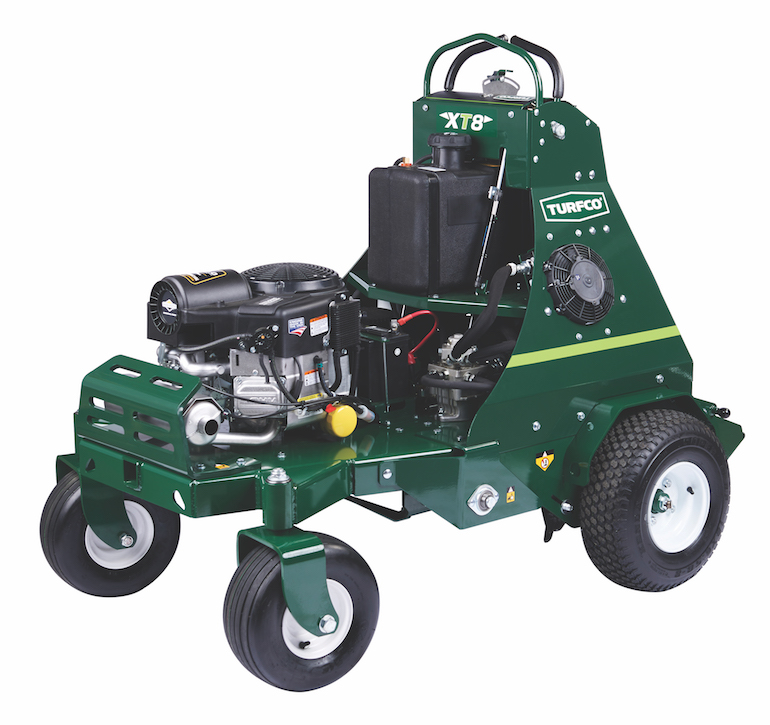
turf carePowered by a 22 hp engine with a top working speed of 7 mph, the stand-on XT8™ Aerator can cover 2 acres or more of terrain per hour with a 30″ aerating width. The XT8 comes equipped with a patent-pending Auto-Depth Control for setting tine depth that is consistent across a property, regardless of turf conditions. The XT8 is built for hard use yet handles with zero-turn agility. In addition, its best-in-class high ground clearance conquers most curbs without a hitch. Turfco knows their customers rely on equipment working reliably in the field, so they developed a patent-pending drive design that uniquely positions the drive chains outside the aeration area, keeping soil and debris away. That’s a huge advantage as some competitive products are experiencing chains breaking while on the job. With the XT8 operators can feel confident when they go out aerating for the season.

The standing platform rests on heavy-duty, shock-absorbing suspension components that reduce fatigue-inducing shocks and vibrations so workers stay rested and job-sharp longer. The big-performing XT8 is also slim enough to slip through a 48″ wide gate, making it a logical choice for residential lawn care in addition to commercial and sports turf jobs.

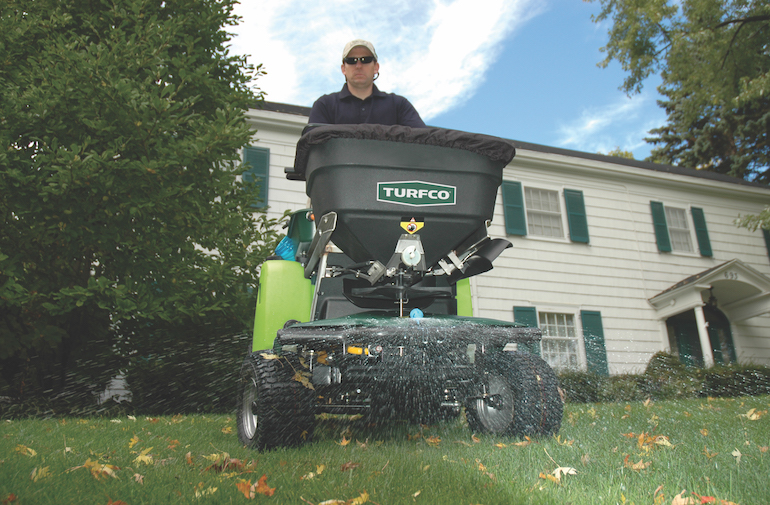
turf careCrews can get up to speed in less time with the T3100™ Spreader and Sprayer Applicator, a compact and versatile, stand-on riding workhorse. The T3100 can cruise through a 36″ gate-opening and hold nearly any hill. The machine provides maximum performance because of its largest-in-class spray capacity of up to 132,000 square feet per fill, available with an add-on 3-in-1 Tank from Turfco.

A new hands-free speed control enables operators to focus more of their attention on spraying and spreading. First-time operators can get up to speed on using the machine quickly, thanks to simplified operating controls and an easy-to-use steering wheel and pivoting front axle assembly that makes handling even on steep and uneven terrain more manageable. Its dual capacity for spreading and spraying makes it a versatile performer for daily use; the adjustable spread system accurately spreads and adjusts to 12′ or 18′ widths (6′ and 9′ effectives). The adjustable high-velocity sprayer puts out extra-large droplets for complete coverage over 4′, 6′, or 9′ widths. The T3100 is of special help to operators with multiple crew members and is intuitive and easy-to-learn.

“We’re dedicated to making products that help superintendents and LCOs better manage the ongoing tasks of turf maintenance, care, and repair,” agrees Scott Kinkead. “We strive to make sure every feature of our machines is focused on how to make them more productive.”

“I grew up in the ‘90s when labor was plentiful and staffing was not an issue for LCOs,” says George. “Today, confronted with a massive labor shortage in the U.S., LCOs need help to do their work more efficiently—and so we as a company are focusing our innovation capabilities on producing equipment solutions that align with the needs to accomplish more work in fewer work hours, while also continuing to find ways to improve the quality of the work that our customers do,” says Scott.

“We feel blessed to be working in the lawn care industry,” says George. “It’s such a pleasure to work in an industry where people love what they do, and love going to work every day.”


The post Turfco’s Century of Turf Care appeared first on Turf.


from RSSMix.com Mix ID 8230377 https://ift.tt/2HC8Kts
via IFTTT

Elevate Fertilizer Know-How

turfgrass fertilization

By Christine Menapace
From the Spring 2019 Issue

Turf fertilization can be a landscaper’s best friend or worst enemy. Get it wrong, and it can cost your business clients and money. Get it right, and you have happy customers and healthy lawns. In fact, dollar for dollar, fertilization can do more to improve poor quality turfgrass, or maintain good quality turfgrass, than any other management practice, according to Dr. Peter Landschoot, professor of turfgrass science at Penn State. But first, you need to do your homework. According to Landschoot, a successful fertilization program requires: 

turfgrass fertilization

(Photo: Getty Images)

  • assessing the turf’s nutritional requirements;
  • understanding fertilizers; and
  • knowing how much to apply and when.

Assessing Nutritional Requirements

The first step in any fertilization program should be soil testing. While this testing won’t provide insight into the amount of nitrogen needed, it will provide insight on phosphorous, potassium, and lime. For some nutrients, it’s the only way to accurately determine how much fertilizer the turf actually needs, yet too often this step is bypassed.

“I know it doesn’t happen a good portion of the time,” says Landschoot. “Golf course and sports turf managers use soil tests, but with landscapers it’s a mixed bag. Though I see an increasing trend of more people using them. In some states, it’s become law that you cannot apply phosphorous to established turf without a soil test.”

Landschoot recommends testing every two or three years, not just when there’s an issue. “Once you see a problem,” he says, “it can take a while to fix it.”

Find a lab, preferably in your region, or at least familiar with the region, that can provide recommendations specifically for turf, not agronomic use. Follow sampling instructions carefully, since they can vary depending on lab, and use the same lab year after year for consistency. “Soil testing is a relatively small investment for the information it provides,” says Landschoot. If you wing it and get it wrong “it can take a lot of time and money to correct.”

Understanding Fertilizer

While most everyone knows to read the fertilizer grade, that trinity of numbers—nitrogen, phosphorous, and potassium—that represents the percentages of ingredients by weight, there’s a lot more to understanding what’s in the bag if you want to get the most bang for your buck. “Learn how to read a fertilizer label,” urges Landschoot. “When I give talks to turfgrass professionals, I always hit on knowing terminology. These terms aren’t fun, it’s just really boring stuff,” he admits. “But it’s just so important.”

Key to understanding a label is knowing the different forms of nitrogen and how these act when applied to the soil. For instance, while the difference between quick release and slow release fertilizers may seem apparent, the label may be a bit misleading. Quick release fertilizers include compounds containing ammonium, nitrate, and/or urea and have 11% to 46% nitrogen. Slow release fertilizers have varying degrees of water insoluble nitrogen, or WIN.

Slow and controlled release nitrogen fertilizers, nitrogen stabilizers, and phosphate management products are all categories of Enhanced Efficiency Fertilizers, or EEFs. The Association of American Plant Food Control Officials (AAPFCO) defines EEFs as fertilizer products that can reduce nutrient losses to the environment while increasing nutrient availability. These fertilizers can slow the release of nutrients for uptake, or abate the conversion of nutrients into loss susceptible forms.

But there’s a difference between slow release and controlled release. In slow release fertilizers, complex compounds release nitrogen by biochemical breakdown, and release time is determined by the compound and biological activity.  In controlled release products, nitrogen is released by diffusion through a polymer coating. The release rate is controlled by soil temperature. (More on this below.)

Landschoot recommends that for a truly slow release fertilizer, look for the term WIN. A bag that claims “slowly available water soluble nitrogen” is likely to act more akin to a quick release fertilizer but may have less potential for burn, he says.

Ultimately, the goal of a nitrogen fertility program is to optimize plant uptake while minimizing leaching, runoff, and gaseous losses. While leaching and runoff can be minimized by not overwatering and turning off spreaders on pavement, gaseous losses (called volatilization) can occur following applications of quick release urea or ammonium in high temperatures on alkaline soil if not watered-in after application. As a result, some quick release products are available that contain additives called “urease inhibitors,” also called “stabilized” fertilizers, that can improve efficiency by reducing gaseous losses. Landschoot says “Certain additives can be good based on the situation.”

As to slow and controlled release, there are many different nitrogen sources. Here’s a summary of how some work:

Ureaform: Urea and formaldehyde with at least 35% nitrogen and 60% WIN. Comprised of three Fractions based on solubility and rate of release with I acting more like quick release and III being the slowest. Dependent on microbial activity and can have low efficiency in first years of use.

Triazones: Liquids made with urea, formaldehyde, and ammonia. Classified as slow release but acting more like urea quick release than other slow release nitrogen sources.

IBDU: Isobutyraldehyde and urea. 90% WIN. Can have three to four week delay in grass response.

Sulfur Coated Urea (SCU): Urea sprayed with molten sulfur and sealant. Releases from microbial action and cracks in the coating. Release varies from granule to granule with variability of coatings.

Polymer Coated Nitrogen: Urea or other nitrogen source coated with a thin layer of plastic resin. Release occurs when water is absorbed by the coating. Can have different coating thicknesses for different rates of release. Release rate increases with higher temperatures but not significantly affected by soil moisture, volume of water applied, soil pH, or microbial activity.

Knowing the difference in nitrogen sources and how they release can aid in efficient timing and application of fertilizers. Know the terminology and talk to reps at trade shows. “Every product has unique characteristics,” says Landschoot. “If you know how to interpret that label, that’s 50% of the game.”

Fertilizer Application: How Much, When, And Frequency

Besides nitrogen sources, spreading the right amount of fertilizer per square foot is key. And yes, you need to do math! A fertilizer calculator developed by Purdue University can be found online. Or, a handy two-step table to make the calculations yourself can be found here.

However, Landschoot recommends knowing how to do the calculations on your own. “We struggle with this with some of our students,” he comments. “But you better know it. You can make one big mistake and you’re losing customers and maybe your job. It’s just what you have to do in this business. It’s why we call ourselves professionals.”

turfgrass fertilization

On small lawns enclosed by sidewalks and driveways, use a drop spreader or a liquid application for greater accuracy. (Photo: Getty Images)

Unfortunately, there is no “one size fits all” optimum number of fertilizer applications. Most programs range from two to four applications a year, depending on amount of fertilizer desired, nutrient release rates, grass species, climate, and costs. “If I were a grounds manager, I’d try to keep applications to about three times a year to save labor,” says Landschoot. However, he points out, “…timing is a more important issue than the number of applications. Think mid to late spring, late summer, and maybe late fall.”

Landschoot also emphasizes that landscapers should keep in mind overall turf health (root growth), not just greening up (leaf growth). Late summer is actually the most effective time of year to fertilize because it helps the grass make carbohydrates (used for root growth and stress tolerance) which leads to healthier, greener grass in spring. (If soil is sandy, use a slow release fertilizer in late summer to minimize leaching.) On the other hand, excess fertilizer in spring can lead to more pronounced leaf growth, but with the possibility of turf stress later in the season. For more detailed information, see Landschoot’s paper.

A Few More Tips

A few more generalized tips to make the most of a fertilizer program include:

  • Returning clippings to lawns can cut nitrogen fertilizer use by up to one-third.
  • Turfgrass species differ in fertilizer requirements. For example, Kentucky bluegrass and perennial ryegrass typically require twice as much nitrogen fertilizer per year as fine fescues.
  • On small lawns enclosed by sidewalks and driveways, use a drop spreader or a liquid application for greater accuracy.
  • With granular fertilizer, consider the SGN, or size guide number, of the granules. It should be between 75 and 250 (75-150 for golf course greens and fairways, and 200-250 for lawns) for optimum spreading efficiency. Buy one bag and check the amount of dust or broken particles (a waste of money) and size uniformity before buying several bags.
  • Don’t apply nitrogen to summer dormant lawns or on frozen winter surfaces.
  • Water-in urea or ammonium fertilizers, especially in warm weather.

To Outsource?

Of course, not every landscaping company wants to take on the responsibility of offering a fertilization program, especially in states with regulations, laws, and licensing requirements. (A helpful list of state fertilizer laws can be found on the AAPFCO website.) In this case, outsourcing is an attractive option.

“It’s definitely more popular than it used to be,” says Landschoot. “It makes sense.” But this shouldn’t mean you’re off the hook. “You still need to know what you’re doing so you don’t pay for what you don’t need. Look at the soil test. Ask questions.”

Menapace is a professional freelance writer and editor with over 25 years of experience in publishing, journalism, copywriting, and marketing.

Share your thoughts in the Comments section below or send an e-mail to the Editor at acos-grove.turf@groupc.com.

The post Elevate Fertilizer Know-How appeared first on Turf.


from RSSMix.com Mix ID 8230377 https://ift.tt/2XWq8iD
via IFTTT

Tuesday, 12 March 2019

Mowers: Buying Cycles And Pricing Prowess

By Lindsey Getz
From the Spring 2019 Issue

mowers

(Photo: Getty Images)

If mowing often feels like it is the most complex part of your lawn care business, you’re not alone. For as basic as a service that mowing is, a lot of lawn care operators say that everything from perfecting their buying cycle of mowers to pricing these jobs accurately feels as though it eludes them.

“Mowing is more complex than a lot of people realize,” says Scott Bierman, owner of Pro-Mow Lawn Care in Charleston, IL. “It’s a simple service but there is a lot involved in setting pricing, perfecting routing, and even mowing turnover strategy. And when these factors are overlooked, it’s easy for the service to start losing you money.”

Rounding Up The Fleet

When it comes to operating a successful mowing service, you need to be sure that you’ve rounded up the right fleet of mowers to get the job done well. The perfect mix of mowers is going to differ from company to company with factors such as the type of properties you’re servicing, size of the jobs you perform, and your budget leading the decision in what will work best.

Bierman says that for his market and the types of jobs that he performs, 60-inch mowers are ideal.

“When it comes to buying parts, and you have all 60s, it makes it a lot easier to service the mowers,” Bierman says. “Brand loyalty is also important to our ideal fleet. Our local dealer is really good to us, and that’s a huge factor in our buying decision.”

Joseph Holland, owner of Majestic Lawn Care & Landscape in New City, NY, says that he prefers to be brand loyal for simplicity’s sake, as well.

“When you are brand loyal, you can stock up on parts so much easier, and from a maintenance point of view that’s very helpful,” Holland says. “We like to keep all parts in stock so that we’re always able to stay up and running, and sticking with the same brand allows us to do that.”

Of course, when shopping for new mowers Holland says that he’s intrigued by new technology—but he prefers to “make sure it’s perfected” before buying.

“I’m an admitted gearhead so I love to get out there and see new technology,” Holland says. “But the one time I broke my own rule in waiting it out and bought a piece of brand-new technology, we had many issues with it. Our rule of thumb is to give it a couple of years and make sure all of the kinks are ironed out before we buy. But we still like to keep on top of what’s coming down the pipeline.”

Creating The Best Buying Cycle

In terms of when to buy, the best buying cycle is going to vary from operator to operator. But there are certainly some strategies to consider.

mowers

When it comes to operating a successful mowing service, it is crucial to assemble an equipment fleet that will meet the needs of client sites. (Photo: Kubota)

Brian Schoenthaler of The Grasshopper Co. says that many lawn care operators prefer to purchase mowers every two to three years in order to have a new warranty and to also operate equipment with the latest features. But some choose to run their mowers much longer—regardless of the warranty. Oftentimes, it’s a matter of personal preference. Even so, trade-in value should be taken into consideration when trading for new equipment, adds Schoenthaler.

Bierman says that his strategy is to buy mowers brand-new and run them for three to four years—or approximately 1,200 to 1,500 hours—before selling them.

“We’ve found that’s about the approximate life expectancy of mowers before they start nickel and diming us with repair costs,” Bierman says. “Beginning in February, we start going through our mowers and decide whether we’re going to fix them or turn them loose. We can usually still get a decent return on them at the 1,500-hour mark, and that’s a factor for us as well. We’re based in a rural area where some homeowners or local farmers have multi-acre properties and are interested in buying a commercial mower.”

Majestic’s Holland says that he aims to get about 2,500 hours or more out of his mowers and achieves this by religiously performing preventative maintenance on the equipment.

“Employing an in-house mechanic makes it easier for us to keep up with regular maintenance, which we think is the main reason we’re able to keep our mowers running as long as possible,” Holland says. “Even just failing to do a basic cleaning can start to take a toll on an engine very quickly. There’s nothing I dread more than a call that a machine broke down in the middle of a job. We do everything we can to prevent that from happening by making sure these machines are maintained on a weekly basis.”

Pricing Jobs

Beyond putting together the ideal fleet and creating an optimal buying cycle, pricing jobs accurately may be another source of contention—and confusion—for lawn care operators. After all, there is a lot to consider when it comes to pricing mowing jobs.

mowers

There are multiple factors to consider when pricing mowing jobs, and choosing ideal equipment for the business’ needs improves competitiveness. (Photo: The Grasshopper Co.)

“Pricing jobs is dependent upon a number of factors including the size and complexity of the areas to be landscaped or maintained, the type of equipment used, the number of employees, and the overhead costs,” says Schoenthaler. “Being competitive involves knowing what prices the local market will bear. Choosing the right equipment can improve your competitiveness.”

Schoenthaler adds that another way to gain a competitive advantage may be found in the purchase and use of diesel-powered mowers. He points out that some diesel mowers burn on average one gallon of fuel per hour compared to 1.65 gallons per hour with a similar-sized gasoline mower.

“Mowing 1,000 hours per year, this can amount to a savings of 650 gallons of fuel annually,” he says. “Because diesel-powered mowers have more torque, these mowers are able to complete jobs, especially in heavy mowing conditions, faster than a gasoline mower can. Consider this real-life example: An operator in Minnesota discovered that he was finishing jobs so much faster after switching to diesel that his day was finishing up by 3:30 [in the afternoon]. He chose to add more jobs rather than knocking off early. The combination of more jobs and fuel savings enabled him to pay for the mower in one year.”

In terms of what to set the price at, the mindset used to be $1 a minute. But the industry experts we talked to say that it’s more complex than this and that each job really does need to be priced out with all factors taken into account. For many companies, there is a minimum that their company won’t go below in regard to setting a price. At Majestic, for Holland, that number is gross earnings of $7,000 for the property for the year. If they’re not going to hit that mark, they’ll send out a new contract, and if the client doesn’t agree to it, they’ll drop them.

A lot of lawn care companies fail to take that hard line, and that’s where they start losing profits, Holland says. Of course, in order to know where they stand, Holland says that he is running numbers constantly.

“I’m in the office every single day doing that—it’s how we stay ahead of the curve,” he says. “I’m always analyzing our gross profit margin on every job. When you put off those numbers, you end up losing money”

Pro-Mow’s Bierman also has that minimum that he says they won’t go beneath.

“Even if the job is going to take us all of five minutes, after factoring in the drive time and other overhead costs, you just can’t go below that minimum number,” he says. “Everyone should know what that minimum is for their business. We use software to derive our optimal pricing. We’re aiming to be more on top of our man hours, equipment costs, and other numbers for accurate estimating.”

Like others, Bierman says he is always looking for ways to be price competitive and says that it all boils down to efficiency. For Pro-Mow, better efficiency has been achieved with smarter routing.

“There was a time when we would set up our mowing schedule based on what the customer wanted, but we just can’t be efficient that way,” Bierman says. “For instance, if we’re in Mrs. Smith’s neighborhood on Mondays, but she wants her lawn mowed on Fridays, then she’s not an ideal client for us and we’ll turn that work down. There was a time when we didn’t like turning work away, and I think a lot of landscape business owners feel that way, but it’s become obvious it’s necessary when it comes to the bottom line.”

Holland agrees that at the end of the day, the bottom line is what counts. “When you’re providing an industry service as competitive as mowing—in an extremely competitive market—you can’t get by without knowing your numbers,” he says. “It’s the difference between profitable mowing and mowing that drags down the rest of your business.”  N

mowersGetz is an award-winning freelance writer based in Royersford, PA. 

Do you have a comment? Share your thoughts in the Comments section below or send an e-mail to the Editor at acosgrove.turf@groupc.com.

The post Mowers: Buying Cycles And Pricing Prowess appeared first on Turf.


from RSSMix.com Mix ID 8230377 https://ift.tt/2VTWrNe
via IFTTT

Monday, 11 March 2019

Meyer Products Super-V3 Snow Plow

snow plow

The all-new Meyer® Super-V3™ snow plow from Meyer Products is made for ¾ ton and larger trucks and comes with a five year warranty. It is engineered with features designed to move more snow, faster and with more control. Users can choose from a V, scoop, or straight blade configuration with push-button ease thanks to a pistol grip controller and independently controlled wings.

The Super-V3 delivers industry-leading ground clearance; users do not have to worry about bottoming out and stacking capability is increased. In addition, Meyer’s exclusive Nite Saber® LED lights offer safer nighttime plowing with less draw on electrical systems.
snow plow
The Super-V3 Plow features a pistol grip controller with self-diagnostics that reduces downtime and a Hands-Free Plowing (HFP) mode that lets users handle the shift lever to control the up/down movement of the blade. Dual-acting locking cylinders provide control, locking the blade position whether plowing forward or backward. Trip-edge moldboards absorb and dissipate the shock so users do not lose the entire load, or subject the truck, plow, and themselves to the full impact. Further, fleet friendly capability allows users to switch out theV3 snow plow with a Meyer straight blade.

snow plowThe Super-V3’s Standard Operating System has a streamlined appearance with an encased power unit and patented cable management system for reliable service. The hydraulic system also features an adjustable drop speed to handle various plowing conditions and meet operator preferences. Additionally, an exclusive upper-sealed center deflector keeps snow and ice off the windshield. On the bottom is an integrated urethane center cutting edge that eliminates snow trails left by ordinary V-plows.

Users can attach and detach the Super-V3 with a simple two-plug electrical attachment, and Meyer’s free-standing jack stand allows V3 height adjustment on uneven or shifting surfaces, making on/off easy in any condition.

All Meyer carbon steel moldboards are painted with Meyer Dura-Slick™ Paint. This automotive-style paint with Teflon® is baked on to the steel for durability and better snow-rolling action.

The post Meyer Products Super-V3 Snow Plow appeared first on Turf.


from RSSMix.com Mix ID 8230377 https://ift.tt/2VPF6ox
via IFTTT

Turf Spring 2019 Issue: Time For Renewal

Turf Spring 2019 Issue

Spring Is A Time For Renewal

Turf Spring 2019 IssueMany of you are in full swing for the spring season, busy revitalizing lawns and landscapes across residential and commercial properties. With the publication of this issue, Turf joins you in that renewal with the official relaunch of the magazine. In 2018, our parent company, Group C Media, Inc., acquired Turf, and as the new editor in chief, I’m looking forward to covering the topics that matter to you and your business—from the technical and practical aspects of turf and tree care, to the ins and outs of business management. Celebrating its 30th year in 2018, our sister publication, Facility Executive, is written for facility management professionals who operate and maintain public and private sites. An important part of facilities work includes groundskeeping and related issues, including aesthetics, water conservation/quality, and pest control. We’ll draw on that expertise to deliver useful content to you here.

With our focus on mowing equipment in this issue, you’ll find the cover story (Mowers: Buying Cycles and Pricing Prowess) provides insight on fleet management. And the authors of the articles on selling your services and securing new and existing contracts offer practical tips to bring in more business. And for My Landscape, we spoke with the head of landscape services at The University of Mississippi about a treasured green space on that campus.

We’re digging in to bring you the latest industry products, best practices, and news, so you can grow your business in 2019. And, we want to hear from you about the articles you read in the magazine and on TurfMagazine.com, as well as suggestions on covering topics you want to know more about in your work. Send e-mails to me at the address below. I look forward to getting to know you this season and beyond!

Anne Cosgrove
Editor in Chief
Turf
acosgrove.turf@groupc.com


Turf Spring 2019 Issue
Table of Contents

Get Equipped: Mowers, Herbicides & Insecticides, Small Engine & Handheld Equipment, and Spreaders/Sprayers

Looking To Increase Your Rates? | Highlight the value of landscape services to your customers.

The Fly-by-night Guys Aren’t Taking Your Business | Doing your homework and tailoring your offerings are keys to ensure new and repeat customers.

Mowers: Buying Cycles And Pricing Prowess | A close eye on mower fleets helps to ensure extended equipment life. Plus, see pricing tips for the upcoming season.

Elevate Fertilizer Know-How | With spring in full swing, here are several tips and tricks to increase fertilization efficiencies.

Keep An Eye On Lawn And Tree Disease | When it comes to disease control, customer education counts.

Biologicals On The Greens | For turf, plant, and human health, golf course superintendents are looking to biopesticides and biostimulants.

My Landscape: The Grove At Ole Miss | Jeff McManus, director of landscape services at The University of Mississippi, talks about maintaining a treasured green space on campus.

The post Turf Spring 2019 Issue: Time For Renewal appeared first on Turf.


from RSSMix.com Mix ID 8230377 https://ift.tt/2SYimB9
via IFTTT