Tuesday, 6 August 2019

Why Kit Homes Are the Cheapest Way to Build a House in Australia

When building a house there are a lot of costs to consider. Virtually every step throughout the construction process comes at a cost. While the price of building a house can be cut down by sourcing cheap locations to build, this is not the only cost cutting option. A kit home allows individuals to buy the land they actually want and build a kit home on top of it without breaking the budget. With kit homes, you can have your dream house on your dream piece of land and still have saved money.

Building a House in Australia

The cost of building a house in Australia is comprised of many underlying factors. From site costs and pre-start costs to variations and finishing costs, building a house in Australia can be costly.

Site costs include expenses relating to preparing the block of land for building upon. These costs pertain to retaining walls, site surveys, soil tests and site clearance.

Pre-start costs start to add up when it comes time to choosing the colours of fittings and materials. Pre-start costs tend to get out of control if you decide to make changes to lighting layouts and other plans that have already been drawn up.

Builders have a mark up of around 20-25% on variations, no matter how big or small. Variations can come in the form of changing the colour of grout tiling or adding another full size room.

It is estimated that the average cost of building a new home in Australia is around $306,885.

A project home with a basic finish costs around $900 per square metre in Adelaide and $1210 in Brisbane. In Melbourne the cost is estimated at $1180 while it is slightly more in Sydney, costing $1190.

Cheapest Locations to Build

It won’t be surprising to most that some of the cheapest locations to build are located several kilometres outside the major capital cities. However, the sheer amount of land on offer for reasonably good value is enough to convince anyone to build their dream home in one of these locations.

The median price for a square metre of vacant land is almost $1000 in the most expensive cities, whereas large blocks in regional areas are on offer for less than $1 per square metre.

Priced at $6000, one of the most affordable locations in Australia is Western Australia. While the land would need earthworks, the 1760 square metres on offer is hard to refuse.

South Australia also offers cheap land by the ocean. A 1085 square metre piece of land close to the water in Port Germein would set you back $15,000. However, the water views are a dream.

Over in Victoria, in the town of Brim, famous for their silo artworks also offers land for value. A 2000 square metre block would set you back $15,000.

Many land owners will note that location is just as important as the house you build. With a block of land in one of these locations and a kit home, you could be well on your way to building one of the cheapest houses in Australia.

Kit Home Prices

The cost of a kit home is affected by a number of things. From permits, materials and labor costs, choosing a kit home doesn’t mean eliminating costs altogether, but rather minimizing them.

With Kitome, the cost of a 3 bedroom kit home starts from just $54,367. A 4 bedroom starts from $67,514 while the cost of a 5 bedroom begins at $91,155.

When compared to a 3 bedroom house in Australia costing anywhere between $160,000 and $195,000, the price of a Kitome kit home speaks for itself. While there are still labour and construction costs to consider, a kit home still works out to be the cheapest way to build a house in Australia.

Start Designing Today

Looking for your dream home? Kitome offers a wide range of fully customisable homes for you to choose from or you can design your own! Talk to the friendly team at Kitome today.

The post Why Kit Homes Are the Cheapest Way to Build a House in Australia appeared first on Kitome.


from RSSMix.com Mix ID 8230377 https://ift.tt/2OFF049
via IFTTT

Monday, 5 August 2019

Small Project, Big Impact

landscape design

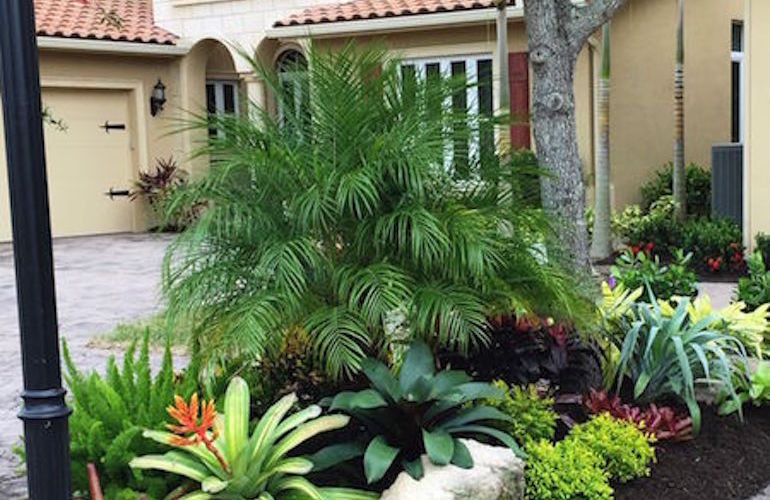
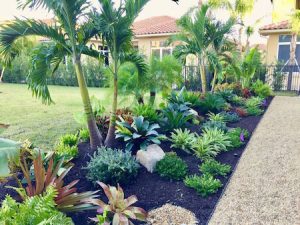
Photoscape LLC of Fort Myers, FL transformed a zero-lot-line property with a landscape design of unique plantings that maximized the 2,600 square foot project. The result? A Silver designation from NALP and five new contracts. 

Not every successful landscape project has to be huge – or complex. It just needs the right elements, carefully executed.

Take the project Fort Myers, FL-based Photoscape LLC did for the Jaksichs family in the high-end Grey Oaks subdivision in Naples.

No more than 2,600 square feet was involved in the job, says Photoscape owner and president Vernon “Oliver” Ray, Ph.D., but the careful use of plantings both in front and behind the zero-lot-line home earned it a 2018 Silver designation in design/build from the National Association of Landscape Professionals.

Ray was contacted by the clients after they’d seen his work on the Houzz website. “They called me,” he says. “They didn’t want me to bid it, they just wanted me to design it and do it. I gave them a bid, as well, but they weren’t taking multiple bids.”

As long-time residents of the Naples area, the Jaksichs wanted a tropical look. However, because of the size of the new home, there wasn’t much space in which to work.

“The front of the house was a whole lot of pavers – or was going to be; we started the install before the pavers went in,” Ray explains. “They knew the abundance of pavers would detract from the beauty of their home, so they wanted an over-the-top landscape package that would pull the eye to the landscape and then the front entrance.”  While it’s not unusual for Photoscape to do paver installations, adds Ray, in this case the company was so busy, that part of the work was subbed out.

The situation in the rear of the home was somewhat similar. Although the back of the house features a pool and outdoor kitchen/patio, it was built to the zero-lot-line. “They had no backyard to speak of,” he says. “We had to talk the homeowners’ association out of six or seven feet of common area on the backside of the house.”

Missing Utilities

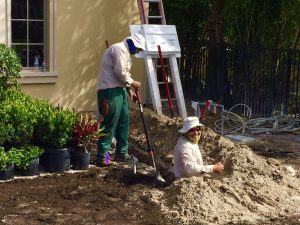
Still, the job should have been straightforward, except that it wasn’t. After taking a day to tear out the areas to be improved, including some old-growth hardwoods, the company began digging to plant some of the eight palm trees that went into the project – and found information on an important utility was missing.

Finding the location of utilities proved a challenge.

“I have photos of my guys in five-foot holes because we had to dig up the whole yard to find where the gas main was coming through,” Ray says. “We realized there was no gas meter to the house, so the gas company had to come out and it delayed our planting for three days while we had plants on the ground.”

Once that was resolved, Photoscape installed both irrigation and lighting in the planting areas. Ray says he particularly loves lighting because it allows clients to enjoy their installations beyond just daylight hours. “It’s all ground lighting, but we also lit up the front of the house with some wall-washers,” he says. “We didn’t do any downlighting from the trees because we were dealing primarily with palms.”

Ultimately, about 2,400 square feet were planted, with the remaining 200 square feet going to floratam sod.

Right Plant, Right Place

Ray prides himself on his planting beds and designating the right plant for the right place. In this case, some beds received full sun, some were in partial sun, and others received virtually no direct sun. “I… use plants that are unique [and] that you rarely see in other landscapers’ designs,” he says. “I search every week on the east coast…Miami and Homestead, where 90% of the growers in the state are located. I just bring back things that are unique.”

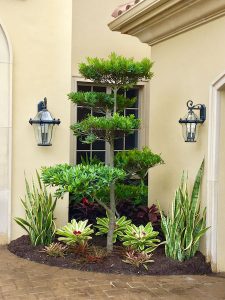
In this case, he’s particularly proud of his use of a false Ashoka or “mast” tree at the home’s front entrance. “It’s very slow growing, but we needed some real height by the front door in a very narrow area,” Ray says. “It gives a very nice look to the front of the home.”

A Japanese blueberry topiary adds height in a small space.

Also, near the entrance is a Japanese Blueberry topiary, with others of the same species going into the small backyard. “The entrance is my favorite feature because it showcases two very unusual trees,” he says. “They bracket the entrance as well as you could with [the] little amounts of dirt as we had to work with. They turned out to be really smashing.”

The planting areas in the front were built up to allow irrigation water to drain off the beds onto the pavers. However, the back offered more of a drainage challenge. “In the back we dug and installed some perforated drains along both sides of the berms,” Ray explains. “The common area was higher than the grade to the house, so we had to put in drains. The plants we put in can take wet feet at times, but not all the time, and we had to find a way to get the water away from the root base of the plants.”

The planting areas in were built up to allow water to drain off the beds onto the pavers.

Boulder Design

While Photoscape didn’t install the aforementioned pavers, it did incorporate some hardscape elements in the design. The planting beds include several boulders in various sizes, some up to several hundred pounds. “They’re moss boulders that I bring in from Tennessee,” Ray explains. “The boulders in Florida are very porous and in this humid climate within six months they’re full of mold and fungus and turn black, so we don’t use them.”

Ray’s other favorite – round river rock – makes an appearance in the back. The client wanted the opportunity to walk in the backyard planting area without muddying her shoes.

“We built a raised area about four inches high from river rock and then put stepping stones on it and banded the area with heavy duty commercial metal edging,” Ray explains. “The river rock and the stepping stone walkway went in at the last minute.”

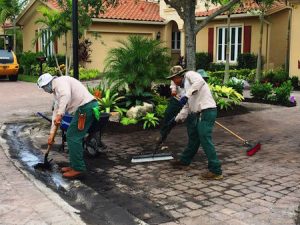
Ultimately, the project took less than two weeks, with Photoscape putting six men on the tear-out and up to a dozen on the rest of the work.

Another challenge: Transporting palm trees to a backyard of zero-lot-line homes.

Besides the headaches presented by the gas line and missing gas meter, Ray says his greatest challenge was getting the trees to the backyard. “We had an articulated loader to get the palm trees back there, but this home is surrounded by zero-lot-line homes, so it was a real challenge to get into the common area,” he says. “We had to take a section of fence and a gate out in order to get back there, but we left the area better than it was before, so it wasn’t a problem.”

The total project came in at just under $50,000. Not only did the clients have Photoscape back later to add potted plants to the pool area, but the neighbors were impressed as well, says Ray. “We got five other jobs off this one before we’d even finished it,” he says. “That’s the greatest compliment. People were walking by before we were finished with the job and giving us their contact info for other installations. That’s the best.”

Schipper is a writer and editor specializing in B2B publishing. She is a partner in Word Mechanics, based in Palm Springs, CA.

The post Small Project, Big Impact appeared first on Turf.


from RSSMix.com Mix ID 8230377 https://ift.tt/2OEFiIA
via IFTTT

Building a Tiny House – Why a Kit Home is the Better Option

Thursday, 1 August 2019

NaturaLawn Dan Collins Scholarships Awarded

NaturaLawn

NaturaLawn

Pictured above: Cole Cerulli, center, during his visit to the NaturaLawn of America Corporate Office in Downtown Frederick, MD. Also pictured from left to right are: Marketing Director Theresa Smith; President Phil Catron; Cole’s parents, Michael and Michelle Cerulli; and Chief Operating Officer Jesse Catron.


NaturaLawn® of America has announced three winners of its Dan Collins Scholarship award. The essay contest, now in its second year, offers high school seniors and college undergraduates a chance to win scholarship money toward higher education.

Originally designed to provide $4,000 to the essay contest winner, NaturaLawn of America instead decided to offer three awards this year due to the outstanding response, as well as the caliber of students. The winners were awarded $4,000, $1,000, and $500 respectively.

The first-place award recipient was Cole Cerulli, of Maryland. This fall, Cerulli will be attending James Madison University to study finance. He is a well-rounded student, accepted into the National Honors Society and Future Farmers of America. Cerulli is also highly regarded by his teachers, mentors, and classmates as selfless and always willing to lend a helping hand.

NaturaLawn

Cole Madsen attends Des Moines Area Community College and is studying turf management.

Cole Madsen of Iowa, a sophomore at Des Moines Area Community College, was selected as the second recipient of the award. He studies turf management and began operating his own lawn care company, Madsen Mowing, in high school. His knowledge of turf management helped him during internships, where his responsibilities included maintaining Minor League Baseball fields and professional golf greens.

The third recipient chosen was Alex Noble, of North Carolina. Noble will be attending the University of North Carolina at Wilmington to major in biology with a minor in either forensic science or marine biology. Noble said receiving the Dan Collins Scholarship award was an honor. He intends to live out the memory of Dan Collins by helping “change the world in his name.”

NaturaLawn

Alex Noble will attend the University of North Carolina at Wilmington.

The award was established in 2017 in memory of former franchise owner, Dan Collins, who passed away from cancer in 2005. “Dan Collins was a ‘larger-than-life’ gentleman who always had a funny story to share, an encouraging word for his fellow franchise owners, and a big heart for giving his best to help others,” said Phil Catron, company founder and president. “Dan’s efforts in promoting NaturaLawn of America and his franchise in the Richmond, VA area can be summed up by a simple five-word question he was so fond of asking, ‘Can I get you started?’”

Applications for the scholarship were accepted this year from March to May. Students were encouraged to submit a personal essay, as well as up to three recommendations for consideration. A retired high school principal familiar with scholarship award determinations evaluated each applicant, with identifiers redacted, to identify the top three winners.

NaturaLawn of America hopes these scholarships will help students prepare for their futures with less financial burden. The company also plans to expand the contest in the future to offer more scholarship opportunities.

The post NaturaLawn Dan Collins Scholarships Awarded appeared first on Turf.


from RSSMix.com Mix ID 8230377 https://ift.tt/336Opoq
via IFTTT

Do I Need to File a Permit for a Pool or Fence in My Bergen County, NJ?

Landscaping your yard or property can create the space that you desire, but it can also help to increase your property’s value in the long run. However, it’s important to know exactly what requirements are needed when making any alterations to your property. You will need to inquire into city regulations and find out what kind of building permits are needed in your area. As with any large project, it’s smart to get the assistance of a professional. Advice and support from a full-service landscaping company can help you make the right decision for your property, and they can also assist with the more bureaucratic aspects, such as acquiring permits.

What do I need to Permit for a Pool?

Residents of Bergen County who are contemplating putting in a fence or a pool will want to know what the requirements are for these types of structural changes before beginning any kind of construction. Although you may believe that since you are making changes to your own property you won’t need to file with the county, that’s not necessarily true. Installing a kiddie pool, or any pool that holds less than 24 inches of water, doesn’t require a permit. However, if you are taking on a landscaping project and installing a larger pool, even if it’s an above-ground pool, you will need to apply for a permit in order to begin construction on your property. Keep in mind that your permit only covers the pool. If you want to construct a structure around your pool, such as building a deck around your above-ground swimming pool, a permit for a pool will not extend to cover that and you will need to apply for a separate one. Since permit requirements vary from town to town, hiring a full-service landscaping company is a great way to ensure that you are in full compliance with any and all regulations in your area. Borst Landscape & Design pursues all permit applications on behalf of its clients and is staffed with experts to assist you and answer all your questions.

best front yard landscape design company in Bergen County, New JerseyAs with obtaining a permit for a pool, you will also need a permit when constructing a fence on your property. For any type of fencing that you install on your property, a fencing permit is required. You will need to fill out your zoning review and then the government will have to approve it before you can get started building your fence.

The bottom line is that you will need permits or zoning reviews to perform most landscape construction projects, and a professional landscape contractor should apply for any permits on your behalf.

With any construction project, you need to make sure that you are doing your due diligence before you begin. Ensuring that you have the proper building permits is a huge step in the right direction. However, you also want to make sure that you are working with experts who will guide you every step of the way. Hiring a full-service landscaping company will help alleviate the stress of filing for a permit for a pool or fence. Additionally, a landscaping company like Borst Landscaping & Design will help create the landscaping that you have envisioned for your home and you will have the support of professionals!

And always remember that performing any work without the proper permits can lead to projects being shut down, fines issued and may cause difficulties in selling your home in the future.

The post Do I Need to File a Permit for a Pool or Fence in My Bergen County, NJ? appeared first on Borst Landscape & Design.


from RSSMix.com Mix ID 8230377 https://ift.tt/2ZpujUh
via IFTTT

Wednesday, 31 July 2019

Pedigree Fungicide SC Now Available In CA

Pedigree™ Fungicide SC

PBI-Gordon Corporation has announced that Pedigree™ Fungicide SC has received registration from the State of California and is now approved for use in California.Pedigree Fungicide SC

Pedigree is formulated to provide control of brown patch, fairy ring, leaf and sheath spot, large patch, red thread, pink patch, yellow patch, southern blight, and gray snow mold.

Labeled for use on golf courses, sports fields, and residential and commercial properties, Pedigree is a flowable suspension concentrate. It has shown safe and consistent performance on creeping bentgrass, Kentucky bluegrass, annual bluegrass, annual and perennial ryegrass, red fescue, tall fescue, Bermudagrass, zoysiagrass, and St. Augustinegrass.

Marketed through a partnership with Nichino America, Pedigree features a proprietary formulation and the active ingredient flutolanil.


The post Pedigree Fungicide SC Now Available In CA appeared first on Turf.


from RSSMix.com Mix ID 8230377 https://ift.tt/2MpRr1r
via IFTTT

National Avocado Day Tree Planting Tips

National Avocado Day

It’s National Avocado Day! Celebrate by planting an avocado tree at a customer property! While locations in frost zones are restricted to featuring these tropical trees in containers, sites where temperatures rarely drop to freezing–such as the southernmost regions of Florida, Texas, Arizona or California–may find these trees a beneficial and attractive addition to the landscape. After all, clients who haven’t indulged the toothpick- in-the-pit-trick have probably at least gobbled up guacamole! So how do you plant and care for avocado trees?

According to information from the Pennington Seed Inc. website, plant avocados in the spring so the tree becomes established well before cooler winter months arrive. Choose a site with full sun and excellent drainage, protected from winds and frost. Allow plenty of room for the tree’s mature size, since they can grow 40 feet tall or more in the ground. Avocados have shallow roots, so plant them at, or slightly higher than, the level they grew at in their pot and avoid planting too deep.
Once established, avocados are simple to maintain, states the Pennington Seed site. Their large, leathery, green leaves and attractive form make them beautiful landscape trees, even when they’re fruitless.  Water the entire area beneath the tree’s canopy deeply and thoroughly, then allow the soil to dry out slightly before watering again. Most avocado roots stay in the top six inches of soil, which can dry out quickly. Newly planted trees may need water two to three times per week their first year, while mature avocado trees need water equal to about two inches of rainfall or irrigation each week during summer.
As to fertilizer, avocados do best with plant foods designed specifically for avocados and citrus, notes the Pennington Seed website. These prefer fertilizers with higher amounts of nitrogen relative to phosphorus and potassium. That means that the first number in the N-P-K ratio on your fertilizer label should be higher than the other two. Pennington UltraGreen Citrus & Avocado Plant Food 10-5-5 provides avocados with an ideal blend of primary nutrients plus added micronutrients, including zinc and iron, which are especially important to avocado health and growth. This premium fertilizer starts feeding immediately, then continues feeding your tree for up to four months.

As a final note, keep in mind that one essential for avocado growing success is patience. Plant a tree, and customers may wait three to four years for fruit. But the result is tasty and nutritious!

The post National Avocado Day Tree Planting Tips appeared first on Turf.


from RSSMix.com Mix ID 8230377 https://ift.tt/2Mt8uPZ
via IFTTT